If you are going through a divorce or separation in Carlsbad, one of the biggest questions you probably have is how child support gets decided. California does not leave this up to guesswork. The state uses a set formula, called a guideline, to figure out how much one parent pays the other. This guide walks through how the formula works, what counts as income, and when a judge might order a different amount.
What Is the Purpose of Child Support in California?
Child support is money one parent pays to the other parent to help cover the cost of raising their child. Both parents have a legal duty to support their kids, no matter whether they were married or not. Once a judge signs a child support order, the paying parent is legally required to make those payments on time.
The goal of child support is simple. Kids should be able to live at close to the same standard of living in both homes, even after their parents split up. That means both parents share the cost of housing, food, clothes, school supplies, and medical care based on what they earn and how much time they spend with the child.
How California Calculates Child Support
California uses a statewide guideline formula. Judges, lawyers, and county agencies all use the same formula, so families in Carlsbad get the same treatment as families anywhere else in the state. The formula looks at two main things: how much each parent earns and how much time each parent spends with the child.
The actual formula looks like this:
CS = K (HN – (H%)(TN))
Here is what each letter stands for:
- CS is the child support amount for one child.
- K is the percentage of the parents combined income that should go toward support.
- HN is the higher-earning parent’s net monthly income.
- H% is the percentage of time the higher-earning parent spends caring for the child.
- TN is the combined net monthly income of both parents.
This formula gets complicated fast, which is why almost nobody calculates it by hand. California offers a free online calculator, and family law facilitators at the courthouse can run the numbers for you too.
Why the Formula Changed in 2024
The income levels and multipliers used in the K value were updated in September 2024. This was the first change to those numbers since 1992. The update was meant to better match today’s cost of living, since prices for housing, childcare, and everyday expenses have gone up a lot since the early 1990s.
Who Usually Pays Child Support
In most cases, the parent who earns more money pays child support to the parent who earns less. But this is not always true. If one parent spends more time with the child and earns a bit more than the other parent, the math can actually work out so that the lower earner owes a small payment. This does not happen often, but it can happen depending on the numbers.
What Counts as Income for Child Support
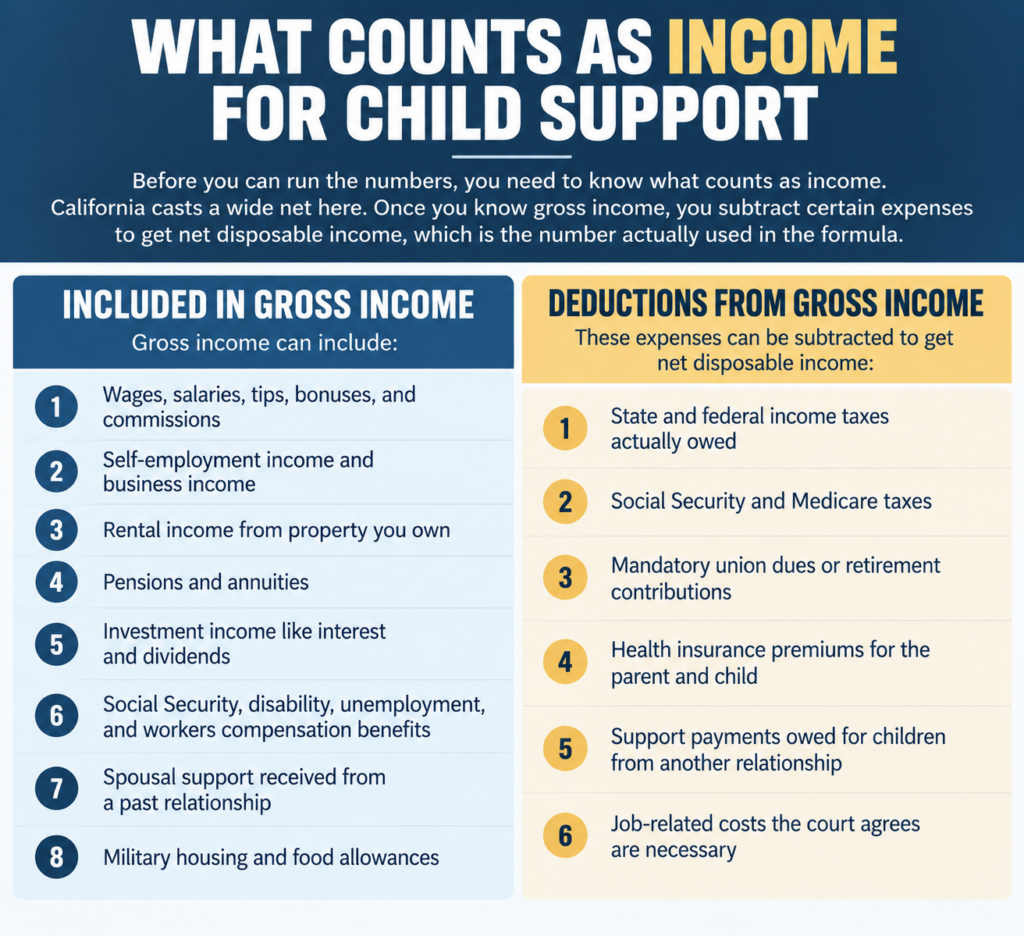
Before you can run the numbers, you need to know what counts as income. California casts a wide net here. Gross income can include:
- Wages, salaries, tips, bonuses, and commissions
- Self-employment income and business income
- Rental income from property you own
- Pensions and annuities
- Investment income like interest and dividends
- Social Security, disability, unemployment, and workers compensation benefits
- Spousal support received from a past relationship
- Military housing and food allowances
Once you know gross income, you subtract certain expenses to get net disposable income, which is the number actually used in the formula. Those deductions can include:
- State and federal income taxes actually owed
- Social Security and Medicare taxes
- Mandatory union dues or retirement contributions
- Health insurance premiums for the parent and child
- Support payments owed for children from another relationship
- Job-related costs the court agrees are necessary
Getting these numbers right matters a lot, since even small changes in reported income can shift the support amount by a noticeable margin.
The Income Shares Model and Other Approaches
California is one of many states that build their guideline around what is known as the income shares model. This model estimates what a child would cost if both parents still lived together, then divides that cost between the parents based on how much each one earns.
Not every state uses this same method. A few other approaches exist across the country:
- The percentage of income model bases support on a flat percentage of the paying parent’s income, without looking as closely at the other parent’s earnings.
- The Melson formula, used in a few states like Delaware, adds extra steps to make sure both parents can cover their own basic needs before support gets calculated.
California leans on the income shares approach because it tries to keep the child’s standard of living close to what it would have been if the parents had stayed together.
Adjustments for Low-Income Parents
California recognizes that a strict formula can be too harsh on parents who do not earn much money. If a parent’s net income falls below a certain level, they may qualify for a low-income adjustment.
As of 2026, California’s minimum wage is $16.90 an hour, and that number gets checked every year against inflation. If a parent’s net income is below what a full-time minimum wage job would bring in, they may get a reduced support amount, unless the other parent can show that a lower payment would be unfair given the circumstances.
How Judges Handle Imputed Income
Sometimes a parent tries to avoid paying child support by working fewer hours or taking a lower paying job on purpose. Courts do not have to accept that. Judges can assign, or impute, income to a parent based on what that parent is capable of earning, not just what they report.
To decide on imputed income, judges look at things like:
- The parent’s work history and past earnings
- Their education and job skills
- Job openings currently available in their field
- Whether health issues or a documented disability limit their ability to work
If you believe income should not be imputed to you, you can push back with proof. Medical records, documentation of a job search, or proof of incarceration can all help show that lower earnings are not your choice.
How Parenting Time Affects the Support Amount
Parenting time plays a big role in the formula, not just income. The more time the higher-earning parent spends with the child, the lower that parent’s support payment tends to be. Courts look at the approximate percentage of time each parent has primary responsibility for the child over the course of a year.
This can include time spent at school if a parent is the one handling drop-off, pickup, and emergencies. If your parenting schedule is still being worked out, it can help to run the calculator more than once using different time-split scenarios so you know what to expect under a few different outcomes.
Extra Expenses Added to Child Support
Base child support is not always the full picture. Judges can add other costs on top of the guideline amount. Some of these are required, and some are left up to the judge’s discretion.
Costs judges must add include:
- Childcare needed so a parent can work or get job training
- Reasonable medical costs not covered by insurance
Costs judges may choose to add include:
- Expenses tied to a child’s special needs, including school-related costs
- Travel costs connected to visitation, especially if parents live far apart
These extra costs usually get split between the parents based on their share of the combined income.
When Support Can Differ From the Guideline Amount
California assumes the guideline amount is the right one in most cases, but a judge can order more or less if the standard number would be unfair. Some reasons a judge might deviate include:
- Both parents already agreed to a different amount and met the legal requirements to do so
- The paying parent has an extremely high income, and the guideline amount is more than the child actually needs
- One parent is not putting in effort that matches their share of parenting time
- Both parents split time evenly, but one pays a much higher share of housing costs than the other
- A parent has deferred selling the family home, and rental value is higher than the mortgage and related costs
- The children have more than two legal parents, which California law allows
- Kids have special medical needs that call for more support
High-Income Cases
When both parents earn a large combined income above the guideline caps, the standard formula may not fit well. In those situations, judges can base support on what the children actually need instead of running the math strictly through the guideline formula. This often comes up in Carlsbad and other coastal San Diego County communities where household incomes tend to run higher than the state average.
Can Parents Agree on Their Own Child Support Amount?
Parents are allowed to agree on a child support number without going through a full court fight. Even so, you still need to start with the guideline calculator to get a baseline number. If you want to agree on something different, a judge still has to approve it.
If the agreed amount is lower than the guideline number, the judge will only approve it if both parents confirm:
- The amount is enough to meet the child’s needs and serves their best interest
- Both parents understand their legal rights around child support
- Neither parent was pressured or forced into the agreement
- Neither parent is currently receiving public assistance
Getting to an agreement is usually easier once both sides understand the guideline number, since it gives everyone a starting point instead of guessing.
Steps to Apply for Child Support
Getting a child support order started involves a few steps:
- Gather financial paperwork, including recent pay stubs, tax returns, and proof of any other income.
- File a request with the court, either as part of a divorce case or on its own through California’s Department of Child Support Services.
- Provide information about parenting time and custody arrangements.
- Attend a hearing or facilitator meeting where the numbers get reviewed.
- Receive a signed court order once everything is approved.
If you were never married to your child’s other parent, you may need to establish legal parentage first before a support order can move forward.
How Child Support Gets Collected and Enforced
Most child support gets paid through income withholding, meaning the money comes straight out of a parent’s paycheck before they ever see it. This gets sent to the other parent, usually by direct deposit.
When a parent is self-employed or income withholding is not possible, a judge may require a deposit large enough to cover up to a year of payments as a guarantee.
If a parent falls behind on payments, California has several tools to enforce the order, including:
- Wage garnishment
- Interception of tax refunds
- Suspension of a driver’s license or professional license
- Contempt of court charges in serious cases
Local child support agencies and the state’s Department of Child Support Services can help with enforcement at no cost.
How to Modify a Child Support Order
Life changes, and child support orders can change too. To modify an order, the parent asking for the change usually has to show a significant change in circumstances. Courts generally look for a difference of about 20 percent or $50 a month, whichever is smaller, before granting a modification.
Common reasons a parent might request a modification include:
- Losing a job through no fault of their own
- A big increase in income
- A change in the parenting time schedule
- One parent being incarcerated
Getting remarried by itself is not enough to change a support order. But if a new marriage brings new financial responsibilities, like children from the new relationship, that can factor into a modification request.
Some orders also include a cost of living adjustment built in, so the payment amount can rise automatically over time without going back to court every time prices go up.
Child Support and Incarceration
Since January 2024, a parent’s child support obligation is automatically paused if they are incarcerated or held in an institution for more than 90 days, as long as they do not have the means to pay while inside. Payments do not start again until the tenth month after release, or sooner if the parent finds work before then.
How Long Does Child Support Last?
In California, child support usually lasts until a child turns 18. There are a few exceptions:
- If the child is still in high school full time at 18, support can continue until they turn 19 or graduate, whichever comes first.
- Parents can agree to keep paying support past 18, such as helping with college costs.
- If an adult child cannot support themselves because of a disability, parents may still have to provide support.
Preparing for a Child Support Hearing
Whether you are working with an attorney or handling things on your own, showing up prepared makes a real difference. Before a hearing, try to:
- Organize pay stubs, tax returns, and proof of expenses in one place
- Bring copies of everything, not just originals
- Be ready to explain your actual parenting time schedule clearly
- Think about whether mediation could resolve the issue before a contested hearing
Judges appreciate clear, organized information. It also helps your case move faster.
Frequently Asked Questions
How is child support calculated for self-employed parents in California?
Self-employed income still counts, but it works a bit differently. The court looks at gross receipts from the business and subtracts real operating expenses to figure out net income. Judges may ask for tax returns, profit and loss statements, and bank records to get an accurate picture, since self-employment income can be harder to verify than a regular paycheck.
Can child support be higher than the guideline amount in California?
Yes, but only under certain conditions. A judge can order more than the guideline amount if the paying parent has a very high income and the child’s actual needs justify a bigger payment, or if there are special circumstances like extraordinary medical or educational costs. The parent asking for more usually needs to show evidence that supports the request.
What happens if a parent refuses to pay court-ordered child support in California?
The state has several ways to enforce payment. This can include garnishing wages directly from a paycheck, taking money from state or federal tax refunds, and suspending a driver’s or professional license. In serious or repeated cases, a parent could face contempt of court charges. If you are owed back support, your local child support agency can help you pursue these enforcement options at no cost.
Get Help With Your Carlsbad Child Support Case
Child support math can get complicated fast, especially once you add in things like imputed income, high earnings, or a parenting schedule that is still being worked out. A small mistake in the numbers can lead to a support order that does not reflect your real situation.
Griffith Young works with Carlsbad families to make sure child support gets calculated the right way, whether you are setting up a new order or asking to change an existing one. Call 858-345-1720 to talk through your case with a free consultation and find out what your next step should be.